



Trading engine
Below is a technical explanation of how the trader works. You do not need to understand all of it. The only thing to remember is: Buys automatically. A pocket is sold only when the sell price is above the buy price. Open positions can be at a loss.
Financial analysis
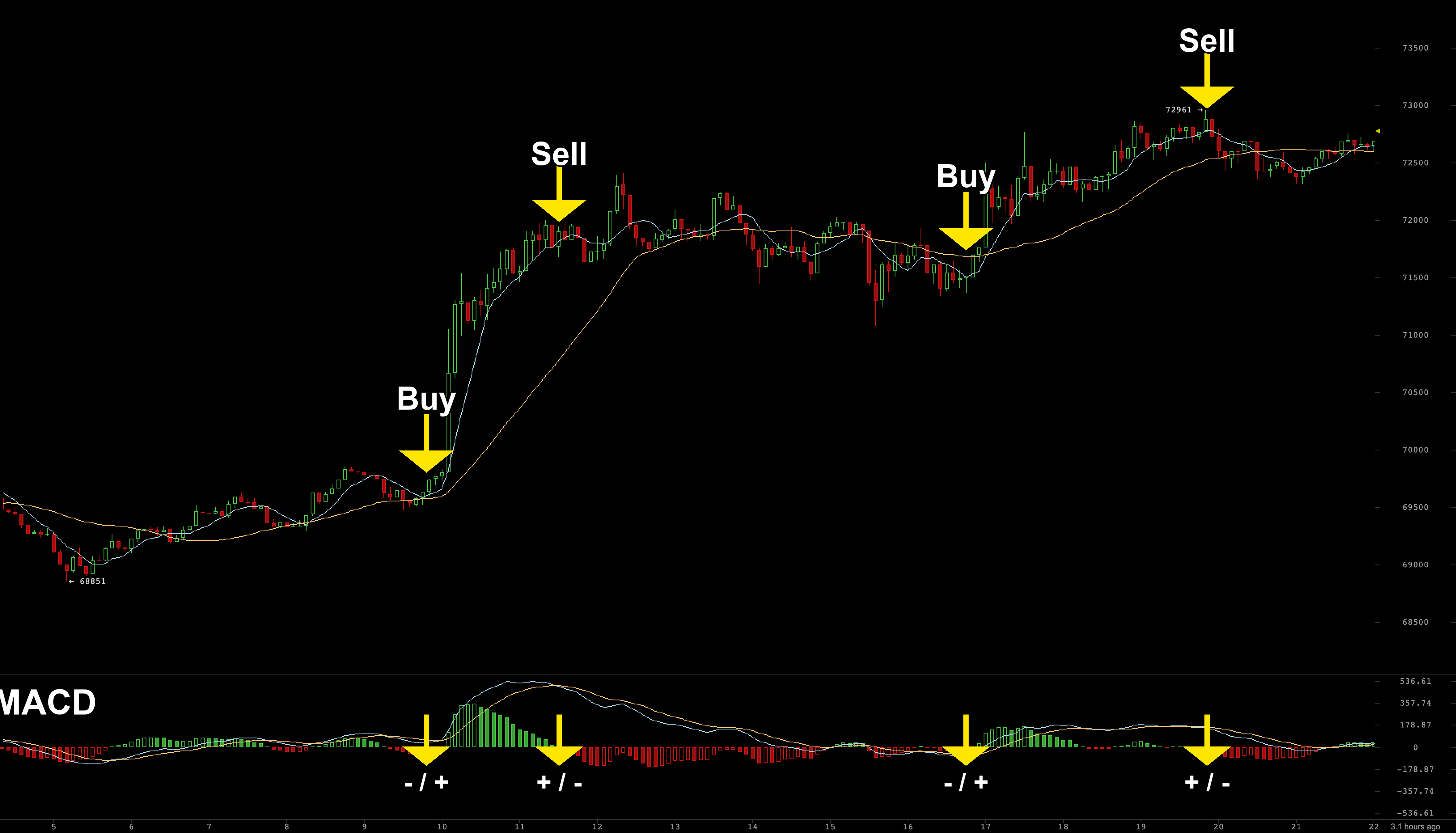
The trading engine uses a MACD analysis to decide when it is a good moment to buy or to sell. See the chart. Favourable buy moments match a MACD crossing from negative to positive. Favourable sell moments match a MACD crossing from positive to negative. The engine has extra rules so that the more favourable buy and sell moments are found. Sometimes a MACD zero-crossing is too weak and is not a good moment to buy.
Buying
The trader buys bitcoins with US dollars (USD) or with euros, depending on the trader type. An EUR/BTC trader trades in euros, a USD/BTC trader in USD.
The MACD analysis tells the trader which buy moments are good. The trader never knows for certain whether a better buy moment will follow, because it cannot see the future. To spread the risk of a favourable buy moment, the trader always buys for a limited percentage of the available euros or US dollars (USD). This percentage is dynamic and depends on the market (see the FAQ for more info). The buy is stored in a pocket. At the next good buy moment the trader buys another pocket for a limited percentage of the remaining euros or USD, and only when the bitcoin price is lower than the price of pockets already bought. The trader does this so that not too many pockets are bought at the same price in a sideways market.
Selling
A MACD crossing from positive to negative is a potentially good sell moment. The trading engine then checks each pocket already bought to see whether it may be sold. The pocket must be sold with a profit of at least 6%. We also want pockets to be sold within three weeks. That is why the minimum profit-margin requirement falls slowly (linearly) to a minimum of 1% after 21 days. After 21 days the minimum profit margin requirement stays 1%.
Simulations
More than 80,000 simulations on historic data (140 million trades) were used to calibrate the rules. Past performance is no guarantee.